
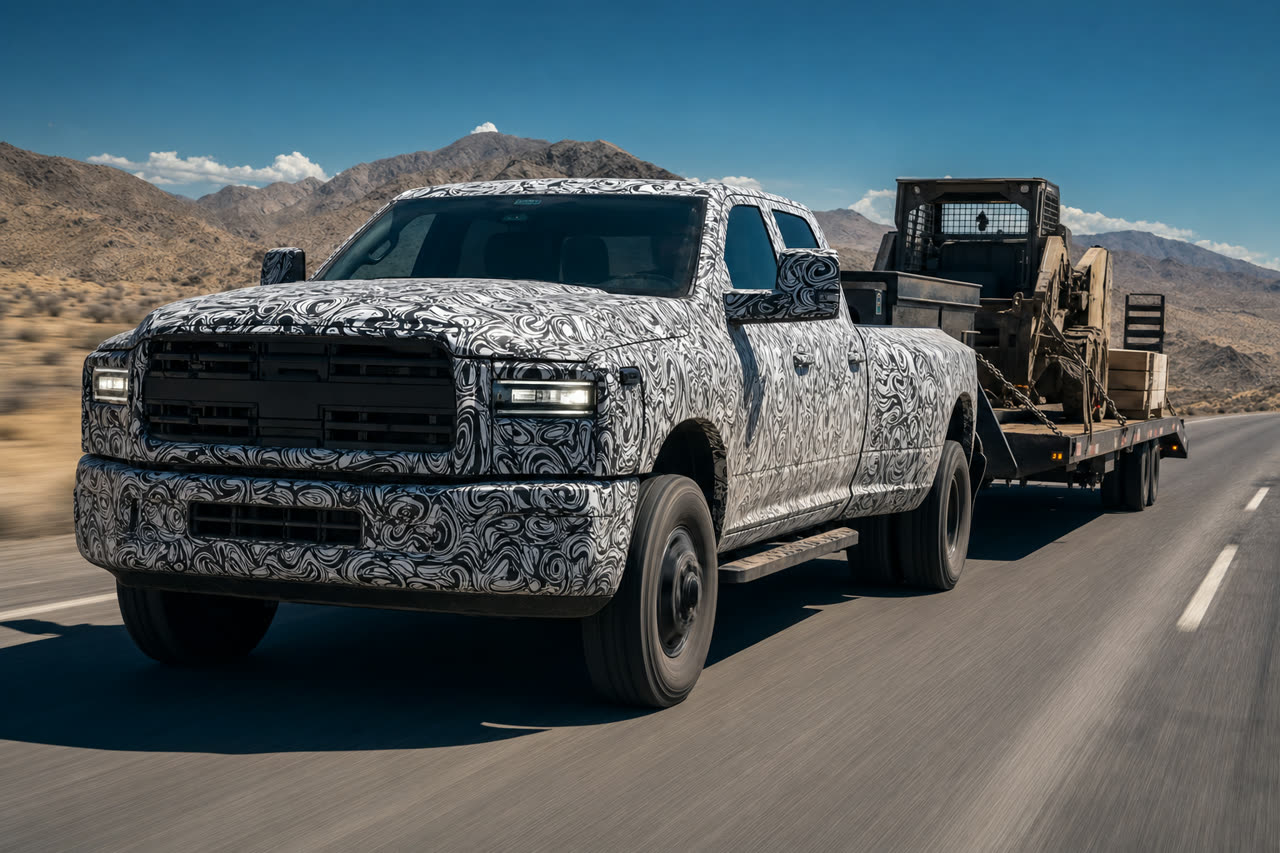
Real-World Diesel Towing Endurance Testing in Extreme Heat: What Breaks First (and How to Measure It)
Author: Nathan Sadjadi
Modern diesel pickups, SUVs, and light commercial vehicles are often sold on the promise of towing and payload capability—yet the true durability question is not “Can it tow?” but “Can it tow all day, at full load, in real traffic, in extreme heat, without abnormal wear, derates, or failures?” Real-world diesel endurance testing answers that question by putting instrumented vehicles on actual highways, grade routes, and desert logistics corridors, then measuring how the powertrain behaves as heat, load, and time stack up.
This article outlines a practical, engineering-focused approach to diesel towing/payload endurance drives performed in real-world conditions—including what to instrument, which failure modes appear first, and how to turn on-road data into actionable durability findings.
Why diesel towing endurance must be validated in real-world driving
Diesel towing durability is a system problem. The engine, turbocharger, charge-air cooler (CAC), EGR circuit, aftertreatment, transmission, cooling module, driveline, brakes, and even tires all interact—especially when the vehicle is operated near its gross combined weight rating (GCWR) for long periods.
In the field, that interaction is shaped by factors that can’t be “averaged out” in controlled environments: stop-and-go merges, long rolling grades, headwinds, heat-soaked rest stops, inconsistent fuel quality, dust ingestion, and driver behavior (cruise control vs. manual throttle, downshift strategy, and braking style). Real-world driving is where borderline thermal capacity, marginal calibration decisions, and packaging constraints show up.
For diesel platforms operating in Texas summers or across GCC corridors (Dubai–Abu Dhabi highways, Riyadh-region routes, and desert-adjacent freight roads), ambient heat plus sustained load can turn small inefficiencies into critical temperature margins.
Build the route: load, heat, grades, and traffic (not just distance)
A meaningful diesel towing endurance campaign is designed around duty cycle coverage, not a single mileage target.
A strong real-world route plan typically blends:
- Hot-weather highway cruising at towing load (steady-state thermal saturation).
- Grade work (mountain or long overpass/rolling-grade corridors) to force high BMEP operation and frequent downshifts.
- Urban congestion segments to stress cooling at low vehicle speed and to evaluate launch/creep durability under trailer load.
- Heat-soak stops and restarts (fuel stops, logistics staging) to observe post-shutdown thermal behavior and hot restart performance.
- Desert-adjacent dust exposure on real roads (not off-road simulation) to evaluate filtration margin and connector sealing over time.
Instead of trying to “hold a perfect speed,” a real-world plan intentionally includes variability. The objective is not to remove noise; it is to measure how the vehicle manages real variability while maintaining acceptable temperatures, torque delivery, and aftertreatment function.
Instrumentation that matters for diesel towing durability
On-road durability data is only as good as the signals you capture and synchronize. For a diesel towing program, instrumentation should cover thermal, mechanical load, and emissions-control behavior.
Core measurement set (typical examples):
- CAN logging: engine speed/torque request, accelerator position, boost, rail pressure, coolant temp, oil temp, trans temp, gear, torque converter state, fan command, DPF soot load estimate, regen status, EGR command.
- Independent temperature measurements (fast-response thermocouples where practical):
- CAC outlet temp (charge-air temperature to intake)
- pre- and post-turbo exhaust temps (EGT)
- DPF inlet/outlet temps
- underhood hotspots near wiring/hoses and the cooling module
- Pressure and flow proxies:
- delta-P across air filter (restriction trend)
- delta-P across DPF (loading trend)
- coolant pressure (boil margin / cap behavior)
- Driveline and chassis loads:
- wheel speed consistency (tire growth and slip)
- optional strain-based measurements for hitch loads in dedicated studies
- GPS + grade estimation: to correlate thermal events with road load.
- Ambient sensors: air temperature, humidity, and (where relevant) dust exposure notes.
The goal is to make events explainable: when a vehicle derates, shifts unexpectedly, or triggers a warning, the test team should be able to answer why within minutes—using time-synchronized, real-world data.
What tends to “break first” in extreme-heat towing (real-world failure modes)
In sustained towing, the first issues are often protective behaviors and accelerated wear mechanisms rather than catastrophic failures.
Common real-world observations include:
Thermal derate or torque limiting
- Triggered by coolant, oil, intake air temperature, transmission temperature, or component protection thresholds.
- Real-world traffic and grade variability can push temperatures across thresholds repeatedly, which is harder on hardware than a single stable condition.
Charge-air temperature creep and knock-on effects
- High CAC outlet temperature reduces air density and can increase EGT for a given power target.
- In hot conditions, small CAC performance losses (fouling, airflow restriction, packaging compromises) show up as measurable boost/EGT penalties.
Aftertreatment regeneration stress under load
- Regens during towing can create high thermal load on the exhaust line.
- Real-world route selection matters: long steady highway segments might allow clean regens; stop-and-go can cause repeated partial events and unfavorable heat patterns.
Cooling module saturation at low speed
- Trailer load in urban traffic forces higher engine load at low vehicle speed, when ram-air is limited.
- Fan strategy becomes a durability factor: fan cycling, fan clutch wear (if applicable), and electrical load effects.
Transmission and torque converter thermal management
- Downshift strategies, torque converter lockup behavior, and trailer-induced launch load all affect heat generation.
- Real-world grade work highlights the calibration’s ability to protect the transmission while still delivering expected performance.
Dust ingestion and connector sealing issues (desert-adjacent routes)
- Even on paved roads, convoys, construction zones, and shoulder driving can raise dust exposure.
- Over time, restriction trends and intermittent sensor faults can appear—especially in high-heat environments where plastics and seals are already stressed.
These are exactly the types of issues that emerge when vehicles are driven in the same conditions customers use—long haul, hot ambient, real traffic, real grades.
Turning on-road towing data into durable engineering decisions
A real-world endurance campaign should produce more than logs; it should produce decisions.
A practical analysis workflow:
- Event-based review: define triggers (e.g., coolant > threshold, EGT spikes, fan duty high for prolonged periods, regen overlap with high load) and automatically tag occurrences.
- Thermal margin mapping: correlate key temperatures against ambient, speed, and calculated grade to determine the conditions where margins collapse.
- Repeatability across routes and days: run the same duty segments on multiple days to separate “one-off” anomalies from systemic issues.
- Maintenance/inspection cadence: combine on-road data with periodic physical inspections (hoses, clamps, air filter condition, coolant concentration, driveline joints, brake wear, tire condition) to connect signal trends to hardware condition.
- Customer-relevant KPIs: focus on outputs that matter in use—frequency/duration of derates, regen interruptions, overheating warnings, limp mode entries, and fuel consumption behavior while towing.
Importantly, the best durability findings often come from mildly uncontrolled conditions: a headwind on one pass, heavier traffic on another, or a hotter afternoon segment. Those variations expose whether the design has robust margin or is living on a narrow edge.
How MotogenX approaches diesel endurance: instrumented, real-world, route-based
MotogenX’s durability philosophy is straightforward: test real vehicles by driving them in the real conditions they must survive—with instrumentation that turns every mile into measurable engineering evidence.
For diesel towing and payload endurance, that means:
- Designing route plans that reflect true customer duty cycles in Texas and GCC environments.
- Running instrumented vehicles with synchronized CAN + independent sensors.
- Capturing thermal, driveline, and aftertreatment behavior during real traffic, real grades, and real heat soak.
- Producing findings that translate directly into design, calibration, and validation decisions.
Closing: diesel towing durability is earned mile-by-mile, on real roads
Towing endurance is where diesel platforms prove their credibility. Extreme heat, sustained load, and long-duration operation reveal thermal margins, calibration robustness, and hardware wear mechanisms faster than almost any other customer use case.
If you need to understand diesel towing durability for a pickup, SUV, or light commercial platform, the most defensible answer comes from real-world driving with an instrumented vehicle—running the same kinds of routes, loads, and temperatures your customers face.
MotogenX delivers this expertise through hands-on programs across the GCC. Explore our vehicle durability & endurance testing services — from road load data acquisition and fatigue testing to OEM homologation.